Unknown's avatar

What Do Architects NOT Do?

Sometimes I tell people I’m a Renaissance Man. (Since I am female, this statement often momentarily confuses people.1) I mean that I am interested in, am capable of, and dabble in, a wide variety of pursuits.

Many, many architects could have taken career paths other than architecture. Our brains work mathematically, scientifically, and artistically. I am an architect, but while I am doing some of the other things I enjoy (making a gorgeous cake, managing my family’s investments, repairing a threshold in my home, carving a jack-o-lantern), I’m not practicing architecture.

Some practicing architects are builders as well as architects. Some practicing architects are also developers. But while they’re doing general contracting or real estate development, they’re still architects, but they are not practicing architecture. Construction, development, and architecture all require different agreements with clients and different liability insurance policies, even within design-build firms.

A bit over a week ago, I read a blog post that I can’t stop thinking about: “Being a Professional Architect is about much more than just designing nice buildings.” This post is on the blog of Build, LLC, a Seattle company that offers architecture and construction services. It was written to outline “a common code of conduct that all professions should abide by.”

The post was inspired by a community news blog post account of a designer in Seattle who declared bankruptcy and “walked away from more than $10 million in debt…” Ten million dollars doesn’t sound like an amount of debt that a small architecture firm could easily rack up, right?

The community news blog post keeps referring to the “architect,” and mentions that the “architecture firm imploded.” But it appears as if it was a development company that failed, and the guy isn’t actually an architect. (Yes, he designs buildings, but he isn’t a licensed architect.)

I’ve written about protection of the title “Architect” before.2 And I’ve written about a news writer’s obligation to use appropriate titles to refer to different types of design professionals.3 This situation is a good example of why I think the title should be protected – some of the comments on both posts are about this guy giving all architects a bad name.

This shouldn’t be happening; this designer’s actions shouldn’t be giving architects a bad name, because what he was doing that caused problems wasn’t actually the practice of architecture, and he isn’t actually an architect.

Financing the construction of buildings is not part of practicing architecture. Practicing architecture does not include constructing buildings.4 Yes, people who practice architecture sometimes do these things, but they are not doing these things at the same time that they’re practicing architecture. Everyone should be ethical in his or her work, but in practicing different types of work, we have completely different obligations to our clients and to the public.

Some consumers actually have no idea what an architect does. Architects themselves should not muddy this issue further. Practicing architecture as a profession is all about designing buildings. An architect discusses a project’s needs with the client, and based on those criteria and other requirements such as building codes, the architect designs, and prepares construction documents for, the building. The architect observes the construction of the building to verify that the building is being constructed in general conformance with the construction documents.

Mixing up the roles of architect, contractor and developer misleads consumers, and might be giving all architects a bad name.

Architects love being architects. But let’s be clear with clients and with the public that when we’re not actually practicing architecture, we’re not working as architects.

_____________________________________________________________________________________

Notes:

  1. “Renaissance Woman” doesn’t conjure up images of someone engaged in artistic or intellectual or scientific pursuits…  I just think of peaceful women sitting or lying down, posing for paintings.
  2. Recent posts of mine about protection of the title “Architect”: “’Sunset Review’ of Licensure for Architects”:  and “Really?!? ‘Who Cares Who’s a Licensed Architect?’”
  3. Post of mine about obligation of a journalist to use the correct title:  “Perpetuating a Misconception”  Note: In February 2013, AIA Colorado sent personalized letters to more than 50 editors and other journalists throughout the state educating them about the title “architect.”  I am thrilled.  http://www.aiacolorado.org/advocacy/about-architect.aspx
  4. Colorado law specifically excludes the “performance of the construction of buildings” from the definition of the “practice of architecture.” I suspect that other states do the same.
Unknown's avatar

Square Peg, Round Hole?

Does anyone else think it’s funny to see CSI MasterFormat 2004 section numbers rammed into the old CSI MasterFormat 1995 categories in construction estimates?

This is what most of the construction estimates that I see look like:

Division 1 General Requirements

01 50 00 Temporary Facilities and Controls

Division 2 Site Work

02 41 19 Selective Demolition

31 00 00 Earthwork

32 12 16 Asphalt Paving

Division 15 Mechanical

22 00 00 Plumbing

23 00 00 HVAC

Division 16 Electrical

26 00 00 Electrical

It looks funny to see section numbers that start with 22 put under Division number 15.  In the olden days, like maybe in 2003, the same info would have looked something like:

Division 1 General Requirements

01500 Temporary Facilities and Controls

01732 Selective Demolition

Division 2 Site Work

02300 Earthwork

02741 Asphalt Paving

Division 15 Mechanical

15000 Mechanical

Division 16 Electrical

16000 Electrical

See how nice and neat that looks with those first 2 numbers of each section matching the Division number of the category?  But then the spec writers went and started using different section numbers.  So there was some confusion, a period of transition…

But now, 9 years after MasterFormat 2004 was published, I’d expect this same info to be categorized like this:

Division 01 General Requirements

01 50 00 Temporary Facilities and Controls

Division 02 Existing Conditions

02 41 19 Selective Demolition

Division 22 Plumbing

22 00 00 Plumbing

Division 23 Heating Ventilating and Air Conditioning

23 00 00 HVAC

Division 26 Electrical

26 00 00 Electrical

Division 31 Earthwork

31 00 00 Earthwork

Division 32 Exterior Improvements

32 12 16 Asphalt Paving

But mostly, it’s not.  Those square pegs keep getting rammed into those round holes.


Unknown's avatar

Communication Breakdown?

Ever feel like you just aren’t being heard?  Ever feel like you aren’t sure exactly what someone’s talking about?  I do.

We hear a lot about how we work in “silos” today; we often work a little bit too independently from the rest of the people we’re supposed to be teaming with.  We make assumptions about the work of others (and then build our work from there); we sometimes make incorrect assumptions (and that affects our work negatively).

I love working independently, and I love working with other architects, but… the more I understand about the other people affected by my work, the better I can do my work.

When architects understand more about the point of view of a contractor, a subcontractor, a manufacturer, a supplier, or an owner, we can understand them better, we can make ourselves understood better, we can have a better team.  We can have a better construction process!

I often work on trying to learn more about the perspectives of others in the construction industry, but my first big step towards a better understanding was taking the CSI CDT exam.

The CDT (Construction Documents Technologist) exam covers a lot of information about preparing, understanding, and interpreting construction documents, and the roles of different groups in the construction process.

It was my first non-project-related introduction to the processes involved on the contractor side of the team.  There’s a lot I’d still like to learn, about the perspectives of the owner and the contractor during construction, but the CDT exam was a good start.

Learning more about where others are coming from can help you avoid communication breakdowns.

  • Final registration deadline for CSI Spring Certification Exams is February 28th.
  • Exams will be offered April 1 – 27, 2013, in the U.S. & Canada.
  • Learn more at http://csinet.org/certification
Unknown's avatar

What is “Building Technology”?

I often mention “building technology” in my blog posts.  I’ve realized that I’m using a term that many people aren’t familiar with.

When I use the term “building technology,” I am not talking about information technology within a building.  I am not talking about the software technologies used to design buildings.  I’m not talking about only high-performance buildings.  I am not talking about only new technologies in building systems.

I am talking about “technology” in terms of its most basic, stripped-down definition: “1. The practical application of knowledge especially in a particular area. 2. A manner of accomplishing a task especially using technical processes, methods, or knowledge.”  (Definition is from Merriam Webster.)

And I am talking about “building” as defined by Webster, too: “The art or business of assembling materials into a structure.”

When I use the term “building technology,” I mean knowledge of the technical processes and methods of assembling buildings.  Drawing proper construction details requires understanding building technology.  Identifying conflicts between the construction documents and the way things are being built on the job site requires understanding building technology.

Knowledge of building technology is an important part of the practice of architecture, but it’s an area in which many of today’s young architects are weak.  This is an area in which I was weak, until I started writing specs and suddenly had starting points for researching my questions (or rather, I suddenly realized what questions I ought to be asking).1

We hear a lot about high-performance new technologies in buildings, but somehow, we seem to have lost the basics of knowledge about detailing foundation, roof, and exterior wall assemblies that meet the minimum of the applicable code requirements.

Without an understanding of basic building technology, an architect cannot properly prepare construction documents for submittal to the authorities having jurisdiction for the purposes of obtaining a building permit.

From the 2009 International Building Code (which has been adopted by many municipalities), Chapter 1, 107.2.4 “Exterior Wall Envelope”:

“Construction documents for all buildings shall describe the exterior wall envelope in sufficient detail to determine compliance with this code. The construction documents shall provide details of the exterior wall envelope as required, including flashing, intersections with dissimilar materials, corners, end details, control joints, intersections at roof, eaves or parapets, means of drainage, water-resistive membrane and details around openings.” 

Without an understanding of basic building technology, an architect cannot demonstrate (to an owner, to a contractor, or to the building department) the constructability of a design.  A building is not made up of bits and pieces erected next to each other; a building is composed of interrelated systems and assemblies that work together to contribute to the building’s proper functioning.  If these components are not carefully selected, specified, and detailed, with the designer taking into account these components’ effects on all the other parts of the building, the completed building may not be able to protect its occupants from drafts, moisture intrusion, mold, condensation, cold, outside noise, or excessive heat.

When I worked as a project architect, I often put off the detailing of tricky conditions until the last possible time.  I know that some other architects do, too.  Drawing construction details is hard work.  There are other, more fun, more easily achieved, tasks that also must be accomplished before a set of construction documents is finished.  But waiting to detail the tough transitions is a problem – when we finally get into the meat of these things, sometimes we realize that the assumptions we’d carried all along were incorrect, and we need a taller parapet, or we need more rigid insulation in the cavity, or we need a building expansion joint.

This detailing work can be less tedious, less torturous, and less time-consuming when we have more knowledge and more understanding of these things.  We produce better construction documents, and help to get better buildings built, when we know more about building technology.

Without an understanding of basic building technology, we can’t contribute much to high-performance building initiatives, such as those by the Building Enclosure Technology and Environment Council (BETEC) of the National Institute of Building Sciences (NIBS), and the U.S. Department of Energy’s Energy Efficiency & Renewable Energy Building Technologies Program, the U.S. Green Building Council, and many cities and states.  Just as the IgCC (International Green Construction Code) is an overlay to the other ICC codes (such as the International Building Code), high-performance building technology does not replace, but enhances, basic building technology.

But… who’s teaching architects about basic building technology today?

Architecture school curricula have gotten heavier on design; architecture graduates are supposed to learn almost everything else they need to know during their internships.  But as more and more knowledgeable gray-haired architects retire, many of the mentors for interns and young architects know less about basic building technology than the mentors of the past.

CSI (the Construction Specifications Institute) recognizes this problem, and is currently exploring the concept of a Building Technology Education Program.  The task team for this program has been charged with formulating “the concept of a building technology education program for participants in the design/construction industry that will benefit the industry by raising the technical knowledge of the participants.”  I don’t think a program like this exists today, and I don’t think that any other organization is working on anything comprehensive like this proposed education program.2

This program is envisioned as being for everyone in the construction industry – not just for intern architects and emerging professionals.  (Architects, remember: we’re part of the construction industry.)  The more that everyone in the industry can understand the concept that all parts of a building are interrelated, and that a modification to one assembly may require modifications to other assemblies, the more effective all of us in the construction industry can be.

Notes:________________________________________________________________________________

  1. Here are some links to past blog posts of mine that discuss technical weakness in architects – including my own past technical weakness.  I have greatly increased my understanding of building technology – anyone can.
    1. https://lizosullivanaia.wordpress.com/2012/02/06/architects-take-back-the-reins/
    2. https://lizosullivanaia.wordpress.com/2012/05/30/the-fervor-of-a-convert-part-one/
    3. https://lizosullivanaia.wordpress.com/2012/05/31/the-fervor-of-a-convert-part-two/
  2. Here’s the roster of the Building Technology Education Program Task Team on the CSI website http://new.csinet.org/csi_services/committees.aspx.  (Scroll down to “FY 2013 Building Technology Education Task Team.”)  If you have suggestions for the team, please contact one of the members.
Unknown's avatar

A Silly Solution

DesignIntelligence has published a new article by Scott Simpson, FAIA. “What Have We Learned?” is well-written and lays out some of the problems in the profession of architecture right now. http://www.di.net/articles/what-have-we-learned/

The article mentions that most owners find architects’ construction documents inadequate.

I just posted the following comment on the article. It’s not showing up yet. It might soon, it might never. I feel strongly about this, so I am sharing it here.

The article states that “…92 percent of owners do not believe that architects’ construction documents are suitable for the purpose intended.”

How can attempts “to prove that ‘good design is good business'” possibly solve this problem? Will SOMEONE ELSE fulfill the task of producing adequate construction documents while architects busy themselves with “becoming conversant” in “good business” and making up new “value propositions” to offer to potential clients?

Adequate information with which to construct buildings will still be necessary, whether it’s in digital form or on paper. Someone needs to produce this information. For hundreds of years, architects have been the people doing this. This is what architects are licensed to do. It still needs to be done. 

Encouraging architects in different directions, without addressing how this need for adequate construction documents is to be fulfilled, is silly.

Bad behavior in toddlers is best addressed by redirection (“Don’t pull the flowers off the bush; here’s a ball instead!”) Redirection is NOT the appropriate remedy for inadequate performance of NECESSARY duties.

Architects ought to be producing good construction documents. I believe that this is our primary obligation under the terms of our licensure. If we don’t, who will?

The Construction Specifications Institute can help. Have you seen the new CSI logo? The new tagline is “Building Knowledge. Improving Project Delivery.” Good construction documents are achievable, but you can’t produce them unless you understand building technology and the principles of construction documentation. If you want to start building your own knowledge about how to produce good construction documents, check out CSI. http://www.csinet.org

New directions for architects may be necessary. But basic obligations of architects are not being fulfilled. We must master the basics before we can move in new directions.

Unknown's avatar

Right, or Not Wrong… or Just Plain Wrong

The gist of David Stutzman’s August 2010 blog post, “’Right’ or ‘Not Wrong’ – Choose Your Specs Wisely,” has remained in my head since I first read it.  “Right” or “not wrong” is something that I think about as I make my way through the preparation of project specifications in an early design phase of a project.  For progress sets in Design Development Phase and early Construction Documents Phase, I always shoot for “right” or “with-lots-of-notes-to-architect.”

In that post, Dave wrote:

Specifications can be written so they are “right” or so they are “not wrong.”   These two are very different.

“Sometimes specifiers are forced to write a “not wrong” spec. This usually occurs when the design schedule is short, when the specifier is asked to start near project completion, when little documentation of product selections exists, or any combination of these. The “not wrong” spec is generic, non-specific. It lists basic products and materials, but does little to address project specific conditions. The detail of terminations and interfaces with adjacent materials – issues that can easily lead to failures – are glossed over or not even mentioned.  This lack of specificity can lead to unnecessary, expensive change orders. Processing these change orders increases construction administration costs, and can result in budgetary disaster on a project.

“To produce a spec that is “right,” the specifier must understand the project and the design intent.” ~ David Stutzman

When “not wrong” specs are further edited to be project-specific, and therefore “right,” they can save time and money for the contractor, owner, and architect.  “Not wrong” specs tend to push design decisions into the construction phase.  Design decisions cost less money when they’re made in the design phases, and specs that are “right” are issued.

Now, from the “Things I Shouldn’t Even Have To Say” file:

“Not wrong” specs are not great, but sometimes I see “just plain wrong” specs.  Sometimes such specs actually contain mentions of the wrong owner, the wrong building, or the wrong city.  (If the spec section is for an engineering discipline, or audio-visual systems, or kitchen equipment, this is often the only way I, an architect, know it’s wrong.)  This is an embarrassment to the entire design team.

I think this happens because of a combination of two factors:

First, in early design, people figure, “oh, we’ll do it like that one project, except for this, and that…” and they think it’s ok to issue, as part of a progress set, the finished specifications from that old project, to make the set look more complete.  It’s not ok.  Every project is different.  If you need a “placeholder,” then consider issuing a complete Table of Contents for the Project Manual, naming all the spec sections that will be included in the final issue, and indicating which sections are not included in this progress issue, but will be included in the next.  Do not issue something that is wrong.

Second, many design professionals simply do not understand the importance of specifications.  Specs are much more than just a “deliverable” due to the owner.  Specifications are an inextricable component of the construction documents, even in early design phases.  If someone is estimating the cost of the project (and someone almost always is, even in early design phases) that person is using the issued progress set specs to help to determine what is supposed to be in the project, and therefore, how much the project will cost.  Don’t issue a spec section if it doesn’t say what you want it to say.  Hint – you must read it before you can know whether it says what you want it to say or not.

“Not wrong” specs can lead an estimator down the correct path, just not quite far enough.  “Just plain wrong” specs usually lead that estimator all the way down the wrong path, wasting time and money for everyone.

If you’re not finished preparing your specs when your deadline comes, issue something less, issue something smaller, but don’t ever issue something that’s just plain wrong.

Unknown's avatar

A Holiday Tale About [Construction] Communication

Some dear relatives-by-marriage of mine hosted us for the Thanksgiving weekend in a warm place.

For Thanksgiving dinner, in addition to my husband, kids, and me, they invited some friends. Twice during the day Thursday, I asked what time people were coming over. The first time, I didn’t get an answer. The second time, I was told that the turkey should come out of the oven at 5:30, so we’d probably eat at 6:30, and that the guests would come over “whenever we tell them to.”

I went for a run, came back to an empty house, and took a shower.

So at 5:00, I was in the kitchen slicing crudités, in strange comfy clothes, with wet hair half up on my head, and wearing no mascara. My husband was still at the beach with the children, one of the hosts was on the lanai, smoking and still wearing golf clothes, and the other was in the shower…

… and the guests walked in.  

They’d been told several days earlier to arrive at 5:00 on Thanksgiving. They could tell that we weren’t ready, and they appeared to be quite uncomfortable. Of the 6 adults involved in dinner, only half of us seemed to be bothered by this mixup, failure-to-communicate, lack-of-modification-of-original-instructions, whatever it was.

Surely an unusual situation, right? And those of us who were unsettled should maybe just lighten up?

Well, no. One story, two messages:

The first message: This kind of thing happens ALL THE TIME in construction communications, and in… well, let’s put my personal life aside. It shouldn’t be happening. Construction documents must communicate clearly.

Sometimes, the Instructions to Bidders document will list one time, date, or location for the bid opening, and another procurement document will indicate another. (Oh, well, it was a typo, no big deal, right? WRONG! These are legal documents! Seemingly tiny conflicts like this could cause a project to have to be bid all over again, or worse! Architects or Owners must check for consistency before issuing documents like this!)

Sometimes, General Notes on the drawings might indicate different window treatments than the rest of the drawings and the specifications show. (Oh, but we talked to the Construction-Manager-as-Contractor about the roller shades; he knows we don’t want those horizontal blinds that the General Notes mention, so it’s ok to just leave that note, right? NOOoooooo! Of course it’s not! It’s not ok to knowingly issue documents with conflicts in them! How are the bidding subcontractors supposed to know what the design team wants? What if they only see the General Notes, and not the drawing notes where what is actually desired is called out? Architects must make sure General Notes on the drawings are relevant and correct.)

Sometimes, drawings will call out storefront, but the specs have a section for curtain wall instead. (But the bidders will figure it out, right? NO!!! Storefront and curtain wall are different things. Architects have to make the documents clear, so as not to waste the bidders’ time, and their own time, during bidding, answering the inevitable question. Architects must ensure that the drawings and the specs are coordinated.)

The entity who is responsible for sending out communications needs to communicate clearly, completely, unambiguously, and in a way that the entity who is receiving the communications can understand. The communicator is responsible for getting the message across.

The dinner guests were not able to divine that, although they had been told to arrive at 5, they should actually show up an hour later, because the host got distracted by family fun at the beach, changed her mind about what time she wanted to receive guests, and failed to tell them to come later than previously indicated.

Bidders, or the constructor, will not be able to know what’s in the sketches or project notebook on the architect’s desk at the office, or what conversations the architect had with the owner two months ago. All that the bidders have to go by is the construction documents. These have to tell the whole story. This is not just to be nice. This is the architect’s legal duty to the owner.

Yes, bidders have to look at the entire set of contract documents, but if a window treatment sub is getting a whole story by looking at just part of the documents, he’ll save himself some time, and stop after reading those General Notes. In the case above, he may have gotten the wrong whole story, because of the architect’s failure to communicate correctly.

The second message: If you, the architect, can’t get it right for the sake of getting it right, remember the guests, er… bidders. Think about how they’ll feel while trying to solve the mysteries of what you were thinking when you drew something that directly conflicted with other documents. Keep in mind that if you make them feel uncomfortable, or if you cause them to waste precious time during bidding, they will remember you for it!

The whole point of dining etiquette is not about using the right fork – it’s about making sure guests are at ease. We have commonly-accepted guidelines about using the correct silverware so that we are starting on the same page, as much as possible, and so that it’ll be easier for everyone to be comfortable, and have a good time.

Do this construction communication thing right. Issue clear, complete, concise, and correct construction documents, and make everyone comfortable. Bidding will go more smoothly, construction will go more smoothly, and your “guests” will be happy to be invited the next time.

Unknown's avatar

Cor-Ten: Why Does It Look Like Rusty Metal?

Ever seen a gorgeous surface that looked like rusty metal?  Well, if it’s weathering steel, often called by a brand name, Cor-Ten, it looks like rusty metal because it IS rusty metal.

This material is really striking, has a great texture, has an interesting color, and is loved by architects.

However, it has some extremely problematic negative aspects… but we might be able to get around some of those.

Check out my latest technical article, published on the website of the Denver Chapter of the Construction Specifications Institute (CSI), “COR-TEN and Other Weathering Steel Alloys in Architectural Applications” .

Unknown's avatar

“Brake Metal” – What Is It?

Have you ever wondered why architects’ construction details often have notes that call out “brake metal” (or, possibly, and incorrectly, “break metal”)?

When I was an architectural intern, working on construction documents, I often used details from previous projects to get started on details for a current project. I often wondered, and sometimes asked, “What is brake metal?”

I never got a good answer.

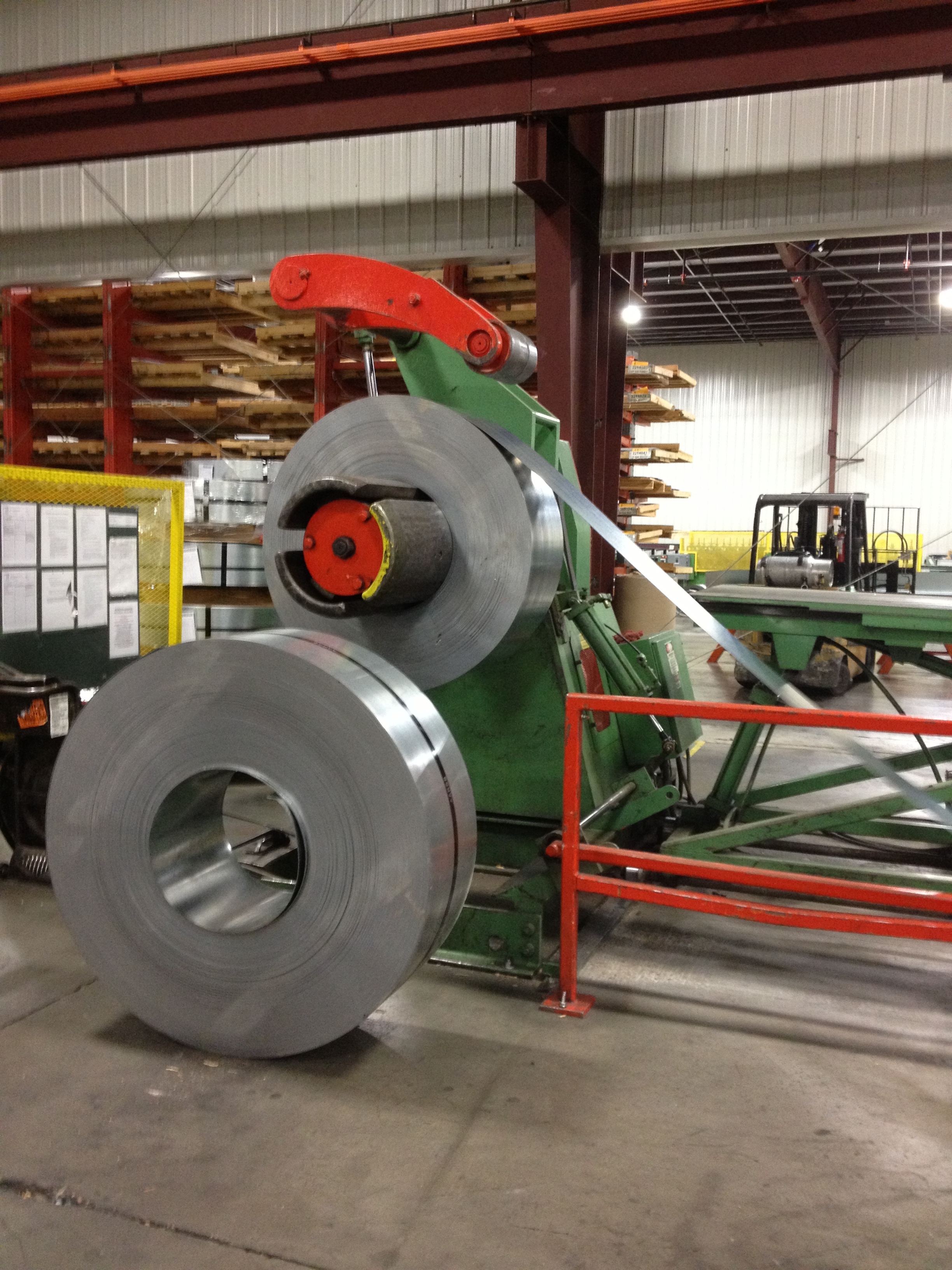
But when I started writing specs, I learned that brake metal is sheet metal that is formed in a press brake. This metal is often specified for sheet metal flashing and trim.

Here’s a press brake in action:

In this photo, above, a length of prefinished sheet metal is being inserted between the male die and the female die of a press brake. Next, the workers will pull up the bottom die, pressing the dies together, which will bend the metal.

Violà! Brake metal.

Many thanks to Metal Sales Manufacturing Corporation for today’s tour of their Colorado plant, where they roll form tons of sheet metal wall and roof panels every year (and brake form lots of sheet metal trim).

This tour was organized by the Denver Chapter of CSI (the Construction Specifications Institute). If you’ve been considering joining CSI, now is a great time to join, because, for one week starting today, CSI has a 20% discount on national membership (November 9th through 16th). This discount is only available to new members joining at the professional (non-student) level. The discount doesn’t apply to your chapter membership, but chapter membership is where you get great benefits such as this plant tour I wrote about today, so it’s worth joining a local chapter, too! Here are the details:

Join CSI at www.csinet.org/join by Friday, November 16th and pay only $192 for national dues, a 20% savings.

  1. Log onto www.csinet.org/join
  2. Select “Join Now”, and then click “Sign Up as a New Member”
  3. Enter Promotion Code CSI1220 when prompted
  4. Click the “Add Discount” button


Unknown's avatar

Really?!? “Who Cares Who’s a Licensed Architect?”

Architect magazine, “The Magazine of the American Institute of Architects,” just published a column by Aaron Betsky titled “Who Cares Who’s a Licensed Architect?”

Architect magazine has perplexed me again.  (Do any actual architects review this stuff before it gets published?)  

Anyway, here’s a link to the column by Mr. Betsky, and below is the response I posted tonight on the Architect website.  I hope that my comment, and a whole bunch of other similar comments, show up tomorrow.  (So far zero comments show up, but it’s late at night right now.)

“‘CLIENTS care’ is the answer to the question ‘Who Cares Who’s a Licensed Architect?’  Sophisticated clients want design professionals who are insured for professional liability.  Design professionals who are not licensed cannot obtain professional liability insurance.

“Governments care, too.  Unsophisticated clients deserve the consumer protection that licensing and regulation by states provides.  A license only demonstrates minimal competence, but that’s so much better for consumers than NO required demonstration of competence, and no regulation of design professionals.  According to a recent report by the Colorado Department of Regulatory Agencies, ‘Title protection plays a vital, fundamental role in protecting consumers from unqualified practitioners. The use of certain protected titles and phrases informs consumers that the individual is regulated, has undergone a certain level of scrutiny, and is qualified to practice under state law.’

“Everyone who cares about good buildings ought to care about licensure too.  ‘Design’ of buildings is total design – down to the flashing details inside the walls.  Someone has to figure out (design) those details, and building owners don’t want the guys in the field making up those detail designs as they go.  In fact, building codes for commercial buildings REQUIRE that the construction documents show details of ‘flashing, intersections with dissimilar materials, corners, end details, control joints, intersections at roof, eaves or parapets, means of drainage, water-resistive membrane and details around openings.’ (2009 IBC)  These construction documents are required to be prepared by design professionals who are ‘licensed to practice their respective design profession as defined by the statutory requirements of the professional registration laws of the state or jurisdiction in which the project is to be constructed.’ (also 2009 IBC)

“As I have written before, in my blog, ‘Only with good construction details can architects’ designs be executed the way they have been imagined.  The designer who can’t draw, or even recognize, good construction details that communicate to the constructor how to build his design will not be a good designer of anything but unbuilt work.’  In other words, the drawings might look good, but the constructed building won’t necessarily look like the drawings, unless the designer can draw the construction details for that building.

“So, a licensed design professional is required by law to prepare the construction documents, including details.  It may as well be an architect – there’s no shortage of licensed architects who need work right now.  Good construction details make better buildings.  Details drawn by the same team who produced the schematic design make better buildings.

“Many, many licensed architects already practice architecture as described in the last paragraph of this column by Mr. Betsky.  Many licensed architects produce designs that transform ‘buildings into frames for our daily lives, frameworks for relationships, catalysts for new ways of living, anchors in a world of change, and many other things that… are difficult to define…’

“Debate away about what these other, difficult-to-define things are, but do not discount the core of what it means to practice architecture.  (Program a building based on a client’s needs, schematically design a building, develop the design, prepare construction documents including construction details and specifications, assist the owner in bidding out the project to builders, observe the construction process to determine whether construction is proceeding in accordance with the contract documents.)

“And for people who are looking for ways to describe to the public what architecture is, why not start with the basics that I mentioned in the paragraph above?  It’s what’s most important in the eyes of the public, governments, lawyers, insurers, and CLIENTS.  The basics MUST COME FIRST.  Licensure is a basic requirement for the practice of architecture.  The difficult-to-define qualities of the practice of architecture can come after that.”