Unknown's avatar

A Silly Solution

DesignIntelligence has published a new article by Scott Simpson, FAIA. “What Have We Learned?” is well-written and lays out some of the problems in the profession of architecture right now. http://www.di.net/articles/what-have-we-learned/

The article mentions that most owners find architects’ construction documents inadequate.

I just posted the following comment on the article. It’s not showing up yet. It might soon, it might never. I feel strongly about this, so I am sharing it here.

The article states that “…92 percent of owners do not believe that architects’ construction documents are suitable for the purpose intended.”

How can attempts “to prove that ‘good design is good business'” possibly solve this problem? Will SOMEONE ELSE fulfill the task of producing adequate construction documents while architects busy themselves with “becoming conversant” in “good business” and making up new “value propositions” to offer to potential clients?

Adequate information with which to construct buildings will still be necessary, whether it’s in digital form or on paper. Someone needs to produce this information. For hundreds of years, architects have been the people doing this. This is what architects are licensed to do. It still needs to be done. 

Encouraging architects in different directions, without addressing how this need for adequate construction documents is to be fulfilled, is silly.

Bad behavior in toddlers is best addressed by redirection (“Don’t pull the flowers off the bush; here’s a ball instead!”) Redirection is NOT the appropriate remedy for inadequate performance of NECESSARY duties.

Architects ought to be producing good construction documents. I believe that this is our primary obligation under the terms of our licensure. If we don’t, who will?

The Construction Specifications Institute can help. Have you seen the new CSI logo? The new tagline is “Building Knowledge. Improving Project Delivery.” Good construction documents are achievable, but you can’t produce them unless you understand building technology and the principles of construction documentation. If you want to start building your own knowledge about how to produce good construction documents, check out CSI. http://www.csinet.org

New directions for architects may be necessary. But basic obligations of architects are not being fulfilled. We must master the basics before we can move in new directions.

Unknown's avatar

Perpetuating a Misconception

Do we have an obligation to stop perpetuating a misconception that we know is out there?  Or is it ok to keep it going, because it’s easier to gloss over it, instead of stopping conversation to correct the misconception?

Nope, I’m not talking about the girlfriend of a certain football player from my alma mater.  I’m talking about the misconception that someone who has a degree from an architecture school and designs buildings is an architect.

Now, there’s a difference between cocktail party conversation and written articles that reach a wide audience.  There are social skills and then there are conversation stoppers; there are manners on one hand and truth in journalism on the other hand.

I recently emailed with a newspaper writer.  He had written an article about the beautiful remodel of a home, and in it, he referred to the “architect” several times.  The designer of the remodel appears to be in the middle of taking his licensing exams, but does not appear to be a licensed architect.

I wrote to the writer that I felt compelled to inform him that a design professional cannot be called an “architect” in Colorado unless he or she is actually licensed as an architect in Colorado, and that although a licensed architect is not required for design work on a house, only a licensed architect is allowed, by law, to call him- or her- self an “architect.”

The writer wrote back that he knew all that, but in his mind, and in the mind of almost all readers, since the design professional has a degree in architecture, he’s an architect.    

What is the writer’s obligation as a journalistAccuracy, or an article that flows like a cocktail party conversation?

What is my obligation as a licensed architect?  I have been told by the Colorado arm of the American Institute of Architects that it is my “duty as a licensed architect to report anyone that is using the term architect and is not licensed to the state licensing board, per the licensing law.”

The architecture profession does a great job of letting the profession know that intern architects shouldn’t call themselves “architect” until they’re licensed.  But the architecture profession doesn’t do a good job of getting the word out to the general public.  And I believe that this can cause problems for consumers.

Here are a couple of recent posts of mine about this issue:

“’Sunset Review’ of Licensure for Architects”: https://lizosullivanaia.wordpress.com/2012/10/17/sunset-review-of-licensure-for-architects/ and

“Really?!? ‘Who Cares Who’s a Licensed Architect?’” https://lizosullivanaia.wordpress.com/2012/10/23/really-who-cares-whos-a-licensed-architect/

If anyone (besides Manti Te’o) has suggestions for me, about how to continue to correct misconceptions, while continuing to practice good manners, please let me know.  I’m really at a loss, here.

Unknown's avatar

Right, or Not Wrong… or Just Plain Wrong

The gist of David Stutzman’s August 2010 blog post, “’Right’ or ‘Not Wrong’ – Choose Your Specs Wisely,” has remained in my head since I first read it.  “Right” or “not wrong” is something that I think about as I make my way through the preparation of project specifications in an early design phase of a project.  For progress sets in Design Development Phase and early Construction Documents Phase, I always shoot for “right” or “with-lots-of-notes-to-architect.”

In that post, Dave wrote:

Specifications can be written so they are “right” or so they are “not wrong.”   These two are very different.

“Sometimes specifiers are forced to write a “not wrong” spec. This usually occurs when the design schedule is short, when the specifier is asked to start near project completion, when little documentation of product selections exists, or any combination of these. The “not wrong” spec is generic, non-specific. It lists basic products and materials, but does little to address project specific conditions. The detail of terminations and interfaces with adjacent materials – issues that can easily lead to failures – are glossed over or not even mentioned.  This lack of specificity can lead to unnecessary, expensive change orders. Processing these change orders increases construction administration costs, and can result in budgetary disaster on a project.

“To produce a spec that is “right,” the specifier must understand the project and the design intent.” ~ David Stutzman

When “not wrong” specs are further edited to be project-specific, and therefore “right,” they can save time and money for the contractor, owner, and architect.  “Not wrong” specs tend to push design decisions into the construction phase.  Design decisions cost less money when they’re made in the design phases, and specs that are “right” are issued.

Now, from the “Things I Shouldn’t Even Have To Say” file:

“Not wrong” specs are not great, but sometimes I see “just plain wrong” specs.  Sometimes such specs actually contain mentions of the wrong owner, the wrong building, or the wrong city.  (If the spec section is for an engineering discipline, or audio-visual systems, or kitchen equipment, this is often the only way I, an architect, know it’s wrong.)  This is an embarrassment to the entire design team.

I think this happens because of a combination of two factors:

First, in early design, people figure, “oh, we’ll do it like that one project, except for this, and that…” and they think it’s ok to issue, as part of a progress set, the finished specifications from that old project, to make the set look more complete.  It’s not ok.  Every project is different.  If you need a “placeholder,” then consider issuing a complete Table of Contents for the Project Manual, naming all the spec sections that will be included in the final issue, and indicating which sections are not included in this progress issue, but will be included in the next.  Do not issue something that is wrong.

Second, many design professionals simply do not understand the importance of specifications.  Specs are much more than just a “deliverable” due to the owner.  Specifications are an inextricable component of the construction documents, even in early design phases.  If someone is estimating the cost of the project (and someone almost always is, even in early design phases) that person is using the issued progress set specs to help to determine what is supposed to be in the project, and therefore, how much the project will cost.  Don’t issue a spec section if it doesn’t say what you want it to say.  Hint – you must read it before you can know whether it says what you want it to say or not.

“Not wrong” specs can lead an estimator down the correct path, just not quite far enough.  “Just plain wrong” specs usually lead that estimator all the way down the wrong path, wasting time and money for everyone.

If you’re not finished preparing your specs when your deadline comes, issue something less, issue something smaller, but don’t ever issue something that’s just plain wrong.

Unknown's avatar

A Holiday Tale About [Construction] Communication

Some dear relatives-by-marriage of mine hosted us for the Thanksgiving weekend in a warm place.

For Thanksgiving dinner, in addition to my husband, kids, and me, they invited some friends. Twice during the day Thursday, I asked what time people were coming over. The first time, I didn’t get an answer. The second time, I was told that the turkey should come out of the oven at 5:30, so we’d probably eat at 6:30, and that the guests would come over “whenever we tell them to.”

I went for a run, came back to an empty house, and took a shower.

So at 5:00, I was in the kitchen slicing crudités, in strange comfy clothes, with wet hair half up on my head, and wearing no mascara. My husband was still at the beach with the children, one of the hosts was on the lanai, smoking and still wearing golf clothes, and the other was in the shower…

… and the guests walked in.  

They’d been told several days earlier to arrive at 5:00 on Thanksgiving. They could tell that we weren’t ready, and they appeared to be quite uncomfortable. Of the 6 adults involved in dinner, only half of us seemed to be bothered by this mixup, failure-to-communicate, lack-of-modification-of-original-instructions, whatever it was.

Surely an unusual situation, right? And those of us who were unsettled should maybe just lighten up?

Well, no. One story, two messages:

The first message: This kind of thing happens ALL THE TIME in construction communications, and in… well, let’s put my personal life aside. It shouldn’t be happening. Construction documents must communicate clearly.

Sometimes, the Instructions to Bidders document will list one time, date, or location for the bid opening, and another procurement document will indicate another. (Oh, well, it was a typo, no big deal, right? WRONG! These are legal documents! Seemingly tiny conflicts like this could cause a project to have to be bid all over again, or worse! Architects or Owners must check for consistency before issuing documents like this!)

Sometimes, General Notes on the drawings might indicate different window treatments than the rest of the drawings and the specifications show. (Oh, but we talked to the Construction-Manager-as-Contractor about the roller shades; he knows we don’t want those horizontal blinds that the General Notes mention, so it’s ok to just leave that note, right? NOOoooooo! Of course it’s not! It’s not ok to knowingly issue documents with conflicts in them! How are the bidding subcontractors supposed to know what the design team wants? What if they only see the General Notes, and not the drawing notes where what is actually desired is called out? Architects must make sure General Notes on the drawings are relevant and correct.)

Sometimes, drawings will call out storefront, but the specs have a section for curtain wall instead. (But the bidders will figure it out, right? NO!!! Storefront and curtain wall are different things. Architects have to make the documents clear, so as not to waste the bidders’ time, and their own time, during bidding, answering the inevitable question. Architects must ensure that the drawings and the specs are coordinated.)

The entity who is responsible for sending out communications needs to communicate clearly, completely, unambiguously, and in a way that the entity who is receiving the communications can understand. The communicator is responsible for getting the message across.

The dinner guests were not able to divine that, although they had been told to arrive at 5, they should actually show up an hour later, because the host got distracted by family fun at the beach, changed her mind about what time she wanted to receive guests, and failed to tell them to come later than previously indicated.

Bidders, or the constructor, will not be able to know what’s in the sketches or project notebook on the architect’s desk at the office, or what conversations the architect had with the owner two months ago. All that the bidders have to go by is the construction documents. These have to tell the whole story. This is not just to be nice. This is the architect’s legal duty to the owner.

Yes, bidders have to look at the entire set of contract documents, but if a window treatment sub is getting a whole story by looking at just part of the documents, he’ll save himself some time, and stop after reading those General Notes. In the case above, he may have gotten the wrong whole story, because of the architect’s failure to communicate correctly.

The second message: If you, the architect, can’t get it right for the sake of getting it right, remember the guests, er… bidders. Think about how they’ll feel while trying to solve the mysteries of what you were thinking when you drew something that directly conflicted with other documents. Keep in mind that if you make them feel uncomfortable, or if you cause them to waste precious time during bidding, they will remember you for it!

The whole point of dining etiquette is not about using the right fork – it’s about making sure guests are at ease. We have commonly-accepted guidelines about using the correct silverware so that we are starting on the same page, as much as possible, and so that it’ll be easier for everyone to be comfortable, and have a good time.

Do this construction communication thing right. Issue clear, complete, concise, and correct construction documents, and make everyone comfortable. Bidding will go more smoothly, construction will go more smoothly, and your “guests” will be happy to be invited the next time.

Unknown's avatar

Cor-Ten: Why Does It Look Like Rusty Metal?

Ever seen a gorgeous surface that looked like rusty metal?  Well, if it’s weathering steel, often called by a brand name, Cor-Ten, it looks like rusty metal because it IS rusty metal.

This material is really striking, has a great texture, has an interesting color, and is loved by architects.

However, it has some extremely problematic negative aspects… but we might be able to get around some of those.

Check out my latest technical article, published on the website of the Denver Chapter of the Construction Specifications Institute (CSI), “COR-TEN and Other Weathering Steel Alloys in Architectural Applications” .

Unknown's avatar

“Brake Metal” – What Is It?

Have you ever wondered why architects’ construction details often have notes that call out “brake metal” (or, possibly, and incorrectly, “break metal”)?

When I was an architectural intern, working on construction documents, I often used details from previous projects to get started on details for a current project. I often wondered, and sometimes asked, “What is brake metal?”

I never got a good answer.

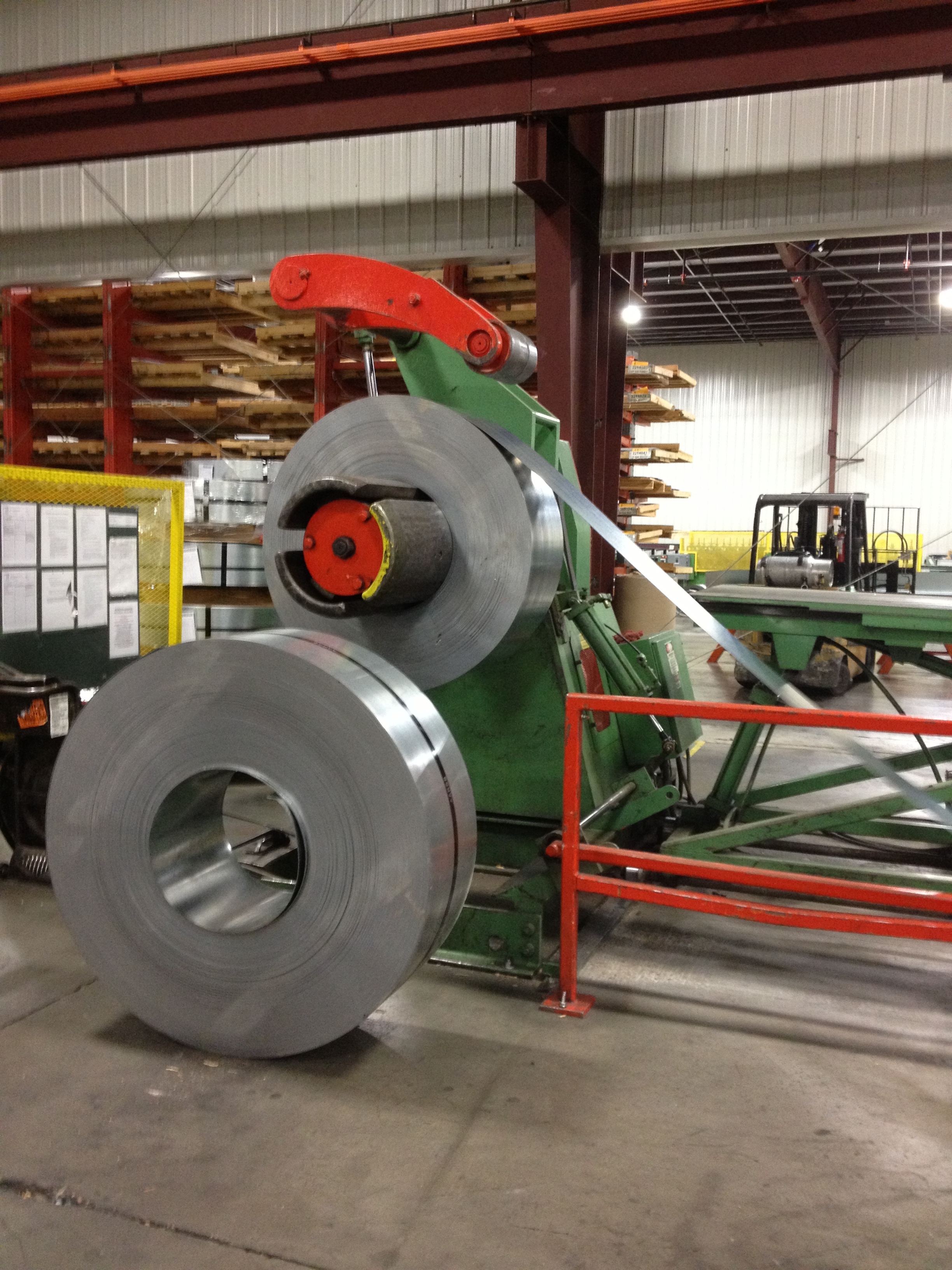
But when I started writing specs, I learned that brake metal is sheet metal that is formed in a press brake. This metal is often specified for sheet metal flashing and trim.

Here’s a press brake in action:

In this photo, above, a length of prefinished sheet metal is being inserted between the male die and the female die of a press brake. Next, the workers will pull up the bottom die, pressing the dies together, which will bend the metal.

Violà! Brake metal.

Many thanks to Metal Sales Manufacturing Corporation for today’s tour of their Colorado plant, where they roll form tons of sheet metal wall and roof panels every year (and brake form lots of sheet metal trim).

This tour was organized by the Denver Chapter of CSI (the Construction Specifications Institute). If you’ve been considering joining CSI, now is a great time to join, because, for one week starting today, CSI has a 20% discount on national membership (November 9th through 16th). This discount is only available to new members joining at the professional (non-student) level. The discount doesn’t apply to your chapter membership, but chapter membership is where you get great benefits such as this plant tour I wrote about today, so it’s worth joining a local chapter, too! Here are the details:

Join CSI at www.csinet.org/join by Friday, November 16th and pay only $192 for national dues, a 20% savings.

  1. Log onto www.csinet.org/join
  2. Select “Join Now”, and then click “Sign Up as a New Member”
  3. Enter Promotion Code CSI1220 when prompted
  4. Click the “Add Discount” button


Unknown's avatar

Really?!? “Who Cares Who’s a Licensed Architect?”

Architect magazine, “The Magazine of the American Institute of Architects,” just published a column by Aaron Betsky titled “Who Cares Who’s a Licensed Architect?”

Architect magazine has perplexed me again.  (Do any actual architects review this stuff before it gets published?)  

Anyway, here’s a link to the column by Mr. Betsky, and below is the response I posted tonight on the Architect website.  I hope that my comment, and a whole bunch of other similar comments, show up tomorrow.  (So far zero comments show up, but it’s late at night right now.)

“‘CLIENTS care’ is the answer to the question ‘Who Cares Who’s a Licensed Architect?’  Sophisticated clients want design professionals who are insured for professional liability.  Design professionals who are not licensed cannot obtain professional liability insurance.

“Governments care, too.  Unsophisticated clients deserve the consumer protection that licensing and regulation by states provides.  A license only demonstrates minimal competence, but that’s so much better for consumers than NO required demonstration of competence, and no regulation of design professionals.  According to a recent report by the Colorado Department of Regulatory Agencies, ‘Title protection plays a vital, fundamental role in protecting consumers from unqualified practitioners. The use of certain protected titles and phrases informs consumers that the individual is regulated, has undergone a certain level of scrutiny, and is qualified to practice under state law.’

“Everyone who cares about good buildings ought to care about licensure too.  ‘Design’ of buildings is total design – down to the flashing details inside the walls.  Someone has to figure out (design) those details, and building owners don’t want the guys in the field making up those detail designs as they go.  In fact, building codes for commercial buildings REQUIRE that the construction documents show details of ‘flashing, intersections with dissimilar materials, corners, end details, control joints, intersections at roof, eaves or parapets, means of drainage, water-resistive membrane and details around openings.’ (2009 IBC)  These construction documents are required to be prepared by design professionals who are ‘licensed to practice their respective design profession as defined by the statutory requirements of the professional registration laws of the state or jurisdiction in which the project is to be constructed.’ (also 2009 IBC)

“As I have written before, in my blog, ‘Only with good construction details can architects’ designs be executed the way they have been imagined.  The designer who can’t draw, or even recognize, good construction details that communicate to the constructor how to build his design will not be a good designer of anything but unbuilt work.’  In other words, the drawings might look good, but the constructed building won’t necessarily look like the drawings, unless the designer can draw the construction details for that building.

“So, a licensed design professional is required by law to prepare the construction documents, including details.  It may as well be an architect – there’s no shortage of licensed architects who need work right now.  Good construction details make better buildings.  Details drawn by the same team who produced the schematic design make better buildings.

“Many, many licensed architects already practice architecture as described in the last paragraph of this column by Mr. Betsky.  Many licensed architects produce designs that transform ‘buildings into frames for our daily lives, frameworks for relationships, catalysts for new ways of living, anchors in a world of change, and many other things that… are difficult to define…’

“Debate away about what these other, difficult-to-define things are, but do not discount the core of what it means to practice architecture.  (Program a building based on a client’s needs, schematically design a building, develop the design, prepare construction documents including construction details and specifications, assist the owner in bidding out the project to builders, observe the construction process to determine whether construction is proceeding in accordance with the contract documents.)

“And for people who are looking for ways to describe to the public what architecture is, why not start with the basics that I mentioned in the paragraph above?  It’s what’s most important in the eyes of the public, governments, lawyers, insurers, and CLIENTS.  The basics MUST COME FIRST.  Licensure is a basic requirement for the practice of architecture.  The difficult-to-define qualities of the practice of architecture can come after that.”

Unknown's avatar

“Sunset Review” of Licensure for Architects

Every decade or so, the State of Colorado asks itself if architects should continue to be licensed and regulated.

Oh, yes, they do. 

It’s called a “sunset review.”  They do it for engineers, too.  Can you imagine states not regulating these professions?  It’s already like the Wild West here in Denver sometimes.  Imagine if there were no rules or requirements governing the qualifications of people who design the bridges we drive under, the schools our kids learn in, the buildings we work in, the houses… oh, wait.  That’s right.  There are very few rules governing some of the people who design the houses we live in, and that’s fine.

But there’s a rule proposed that, if adopted, will govern one thing about some of the people who design houses.  And that’s a good thing.

The current statutes, or laws, indicate that unless someone is a licensed architect, he or she cannot claim to be an architect, and he or she cannot offer to practice “architecture.”1  But when it comes to enforcement of this statute, not much is being done to stop home builders and home designers from offering “architecture” to consumers, even if there’s no licensed architect on their staffs.

Now, State laws do not require that the person who designs a house be a licensed architect.  Actually, there are a lot of building types that the State does not require a licensed architect to design2 (one-, two-, three-, and four-family dwellings, accessory buildings commonly associated with such dwellings, AND garages, industrial buildings, offices, farm buildings, and buildings for the marketing, storage, or processing of farm products, and warehouses, that do not exceed one story in height,exclusive of a one-story basement, and, under applicable building codes, are not designed for occupancy by more than ten persons.)

So, you don’t need to hire a licensed architect to design your new house, or your new garage, or your new small one-story warehouse.

But, some people who are not licensed architects are using the term “architecture” on their websites and in marketing materials.  These unlicensed home designers are not architects, they have not passed the licensing exams, they have not demonstrated that they possess a minimal level of competence, they cannot get professional liability insurance, and they cannot be prohibited from continuing to offer home design services even if they have proven to be incompetent.  They are not regulated.  They are allowed to design homes, but they are not allowed to call themselves architects.  They should not be allowed to use derivatives of the word “architect,” because doing this misleads consumers into believing that they are hiring licensed, regulated professionals, who are subject to scrutiny by regulators who strive to ensure that consumers are protected.

According to the Colorado Department of Regulatory Agencies (DORA) sunset review report3 that just came out on Monday, “Sunset reviews focus on creating the least restrictive form of regulation consistent with protecting the public.  In formulating recommendations, sunset reviews consider the public’s right to consistent, high quality professional or occupational services and the ability of businesses to exist and thrive in a competitive market, free from unnecessary regulation.”

The report indicates that the practice of architecture is regulated because “there is a potential for catastrophic harm if these practices are performed incompetently. These professionals generally carry an immense amount of  trust in their competency. They all are trustees of the public financial welfare. Moreover, many architects and engineers deal with health-safety issues on a daily basis.”

The DORA report made 14 specific recommendations.  The primary recommendation is that the practice of architecture continue to be regulated by the State.  (This is a good thing, one that seems to go without saying, but which needs to be said every decade or so in Colorado.)

Recommendation number 13 is that the State should “Reinforce consumer protections by protecting derivatives of the word ‘architect.’”  Here’s the text of that recommendation:

“Title protection plays a vital, fundamental role in protecting consumers from unqualified practitioners. The use of certain protected titles and phrases informs consumers that the individual is regulated, has undergone a certain level of scrutiny, and is qualified to practice under state law.

“Some unlicensed/unqualified people skirt the intent and protections of the Architect Act by advertising that they perform ‘architecture’ or ‘architectural design.’ However, the use of these derivative terms sometimes confuses consumers who are procuring design services that are actually being performed under an exemption to the Architect Act. They believe they are hiring an architect because of the use of a derivative term.

“The Engineer Act prohibits the use of the derivative words ‘engineer’, ‘engineered’, or ‘engineering’ in any offer to perform the services to the public unless the person is a licensed professional engineer.

“Following the standard set by the Engineer Act, the General Assembly should extend a comparable scope of protections to the public in the Architect Act. Similarly, limiting the use of derivative terms in advertising to licensed architects will ensure that only qualified individuals represent themselves to consumers as architects.

“The General Assembly should reinforce consumer protections by protecting derivatives of the word ‘architect.’”

One of the recent actions taken by the Colorado State Board of Licensure for Architects, Professional Engineers, and Professional Land Surveyors has been in the news this year, and is a good example of why these professions should be regulated, and how regulators can protect consumers and the general public.  You may have heard about the Meeker Elementary School, the one-year-old school building in Meeker, Colorado, that was closed because of structural problems that made the school susceptible to structural failure (collapse) in the event of high winds.  The structural engineer who designed the structure for that building (which housed a whole elementary school full of kids for a year) has been disciplined by the Board of Licensure and has had restrictions placed on his license to practice structural engineering.4

Yes, those school building drawings went through the permitting process at the building department.  But the building department’s job isn’t to check all the work of the engineer or architect – the stamp and signature of the design professional means we checked our own work.  The structural engineer is the one responsible for those column and beam calculations (to make sure the roof doesn’t collapse).  The architect is the one responsible for things such as detailing the flashing properly to keep rain out of the building (so that steel structural studs in the wall don’t corrode and fail), and detailing the roof parapet coping properly (so that it doesn’t fly off in high winds), and for detailing and specifying below-grade waterproofing properly (to keep moisture out of below-grade spaces so that mold doesn’t grow in the walls, ruin finishes, and make people sick).

Licensed architects are expected by the State to do the things mentioned above.  If they don’t do them properly, they may be disciplined.  People such as home designers who are not regulated by the State cannot be required to do these things, and there are no regulatory consequences if they don’t do them; they can keep on doing what they’ve been doing.  Ok, fine, but unlicensed people offering home design services must not be allowed to imply that they are architects.

The recommendation by DORA to “Reinforce consumer protections by protecting derivatives of the word ‘architect’” is a good recommendation, one that the legislature should positively act on when the recommendation officially comes before them in 2013.

______________________________________________________________________________

Notes:

1.  From the portion of the  Colorado Revised Statutes that govern the practice of architecture: http://www.dora.state.co.us/aes/Statute-ARC.pdf  “12-25-305. Unauthorized practice – penalties – enforcement.  (1) Any person who practices or offers or attempts to practice architecture without an active license issued under this article commits a class 2 misdemeanor…”

2.  From the portion of the  Colorado Revised Statutes that govern the practice of architecture: http://www.dora.state.co.us/aes/Statute-ARC.pdf  “12-25-303. Exemptions. (1) Nothing in this part 3 shall prevent any person, firm, corporation, or association from preparing plans and specifications for, designing, planning, or administering the construction contracts for construction, alterations, remodeling, additions to, or repair of, any of the following: (a) One-, two-, three-, and four-family dwellings, including accessory buildings commonly associated with such dwellings; (b) Garages, industrial buildings, offices, farm buildings, and buildings for the marketing, storage, or processing of farm products, and warehouses, that do not exceed one story in height, exclusive of a one-story basement, and, under applicable building codes, are not designed for occupancy by more than ten persons; …”

3.  For the entire October 15, 2012 report, “2012 Sunset Review: State Board of Licensure for Architects, Professional Engineers, and Professional Land Surveyors” go to the Department of Regulatory Agencies Website.  It’s the 3rd report listed.

4. Articles on Meeker Elementary from the Denver Post:

http://www.denverpost.com/news/ci_19605374?source=pkg

and

http://www.denverpost.com/breakingnews/ci_20293795/board-lays-out-case-against-meeker-school-engineer?source=pkg

Unknown's avatar

Masonry: Something New Every Day

Masonry.  It’s an ancient form of building material, but there’s an awful lot to learn about it.

One thing that’s important to remember is that masonry (including brick, CMU, stone, and mortar) is porous and absorptive.

Masonry walls that are under construction should be protected from rain and snow (at the tops, and at window openings), so that the masonry wall doesn’t absorb too much water.  If saturated masonry is not allowed to dry out before being closed in, moisture-related problems, such as exterior efflorescence, or even interior moisture problems, may occur.

Here’s my latest post about this, and how building codes address this issue, in the brand new Denver Chapter CSI Blog: “Protection of Unfinished Masonry Walls.”


Unknown's avatar

Cool Pictures of Old Buildings

There’s a Frank Lloyd Wright-designed house in Phoenix that’s at risk of being demolished in a couple of months.  Here’s the New York Times article about it.  After Mike Brady, Frank Lloyd Wright is the most famous American architect ever,1 so how is this happening?  How is it possible that cool buildings designed by famous architects can get knocked down?  The answer is that sometimes the people who want to save them just get there too late.

But this post isn’t about “The Brady Bunch,” Frank Lloyd Wright, or mid-century modern homes.  It’s about Denver and its heritage.  Right here in Denver, buildings by less famous architects, buildings that are integral parts of their neighborhoods, buildings that are important parts of the city’s history, are at risk.

Once in a while, a century-old masonry building, that, with careful maintenance, would still be around for another 100 years, gets razed to make way for new construction.  Most of the new construction in Denver is unlikely to last as long as 50 years.  This type of replacement is not sustainable, this is not green, this is not good for Denver’s urban fabric and its urban dwellers.  People need to become aware of these buildings early, before they become at risk of destruction.  Sure, there are property rights issues that arise sometimes, but if we start talking about rights, we cannot ignore the property rights of the surrounding property owners, and the rights of the citizens to these parts of their heritage.

On to the cool pictures of the old buildings – or the links to them, anyway…

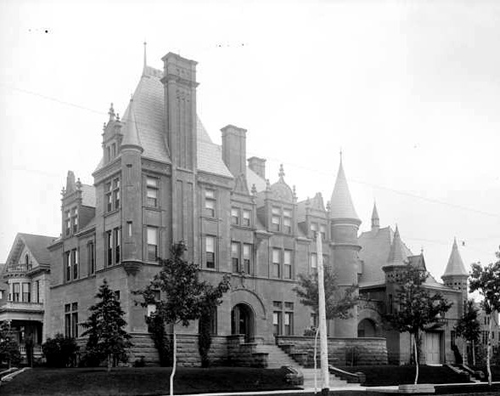
Two really special buildings that I’ve been in recently, the Croke-Patterson-Campbell Mansion and the Wilbur S. Raymond House, have been preserved and restored, and are currently the homes to a couple of bed and breakfasts.

Here’s a great old photo of Denver’s Croke-Patterson-Campbell Mansion, taken in 1892.  It looks almost too fantastic to be real.  The building has since lost some of that magnificent chimney, and many of the finials, but it’s still breathtakingly beautiful – here’s a recent photo (scroll down after the page opens).  The Croke-Patterson-Campbell Mansion has just started to operate as a bed and breakfast, the Patterson Inn.

Sadly, much of the original neighborhood fabric around the Croke-Patterson-Campbell Mansion has been lost.  But the Wilbur S. Raymond House is very much a part of a historic Denver neighborhood, the Wyman Historic District.  Here’s an old photo of the Raymond House.  It’s been the Castle Marne Bed and Breakfast since 1989.  This is my favorite image of the more recent images I’ve found online.  Here’s a good image showing its famous roses.

The neighborhood fabric and the Wilbur S. Raymond House enhance and enrich each other.  Cities aren’t made up of scattered signature buildings, and historic preservation shouldn’t be approached in that manner, either.  Cities are composed of neighborhoods, which are composed of buildings of varying significance.  We need to protect special buildings, but we need to go a step further and also protect the individual historic buildings that may not be as prominent, but without which, historic neighborhoods would not be complete.  Obviously, important buildings are at risk (such as that Frank Lloyd Wright house in Phoenix).  But neighborhood fabric buildings may be even more at risk.

Historic buildings are irreplaceable, whether they’re outstanding, or more “background” buildings.  As an architect and architectural specifications writer, and the owner of an old house, I’m intimately familiar with the differences between the construction practices of today and the construction practices of a century ago.  Buildings are not built the way they used to be.  In other words, “they don’t make ‘em like that anymore.”  (“They” could, but “they” don’t.)  Old masonry buildings are more durable, they can take much more neglect and mistreatment, than new buildings (even new buildings with brick on the outside).  It’s because of building science – a topic for another post.

Architects, engineers, and constructors cannot make up for occupant behavior in most new construction, but old buildings, with plaster finishes, hardwood floors, and multi-wythe loadbearing masonry exterior walls, can take some abuse and neglect from occupants, and will continue to be able to withstand use.  Old buildings can often be adapted to new uses, whereas buildings built in the last 50 years are usually difficult to use for purposes other than their original uses.  Multi-wythe masonry walls and plaster finishes are more forgiving of moisture intrusion than buildings built with newer methods of brick veneer on exterior framing, and gypsum board finishes.

People used to build with multi-wythe masonry and plaster because they didn’t have other good options.  Today, we have less-expensive (and less-durable) options, which have made multi-wythe masonry and plaster much more expensive options.  If you want a durable building, in the long run, it’s probably a better value to use what you already have… and preserve an old building.

I encourage people who are interested in helping to preserve our built heritage to get involved with local preservation groups.  If you live in Greater Capitol Hill in Denver, as I do, your local preservation group is the CHUN (Capitol Hill United Neighborhoods) Historic Preservation Committee.  (If you don’t know what your group is, but want to get involved, leave a comment on this post and I’ll help you find your group.)

_____________________________________________________________________________________________

Notes:

  1. I have to thank Jules Dingle for the Mike Brady comment.  Sophomore year in college, Jules said that Mike Brady is the most famous American architect.  Obviously, that comment still cracks me up today.

For further reading:

  1. In 1967, the City of Denver, in the Landmark Preservation Ordinance in the Municipal Code, declared that “the protection, enhancement, perpetuation and use of structures and districts of historical, architectural or geographic significance, located within the city or its mountain parks, is a public necessity, and is required in the interest of the prosperity, civic pride and general welfare of the people.”  And that “the economic, cultural and aesthetic standing of this city cannot be maintained or enhanced by disregarding the historical, architectural and geographic heritage of the city and by ignoring the destruction or defacement of such cultural assets.”
  2. Denver’s ordinance followed the National Historic Preservation Act of 1966, in which the U.S. decided that“the preservation of this irreplaceable heritage is in the public interest so that its vital legacy of cultural, educational, aesthetic, inspirational, economic, and energy benefits will be maintained and enriched for future generations of Americans,” and that “although the major burdens of historic preservation have been borne and major efforts initiated by private agencies and individuals, and both should continue to play a vital role, it is nevertheless necessary and appropriate for the Federal Government to accelerate its historic preservation programs and activities, to give maximum encouragement to agencies and individuals undertaking preservation by private means, and to assist State and local governments and the National Trust for Historic Preservation in the United States to expand and accelerate their historic preservation programs and activities.”